• Home
  • Articles
    • Front Page
    • General Interest
    • Snippets
    • Letters to the Editor
    • Council Comments
  • Special Interests
  • Our Community
    • Our People
    • Question of the Week
    • Jobs in the Central West
    • Be Seen
    • What’s On
    • What’s Hot
  • Features
    • Women in Business
    • Rural Round Up
    • My Place
    • Loving Local Living
    • Wellness Wise
    • Just a Short Drive
    • Real Estate
  • Sports
    • Bowls
    • Cricket
    • Equestrian
    • Footy Tips
    • Golf
    • Netball
    • Rugby League
    • Rugby Union
    • Soccer
    • Touch Football
  • Classifieds
  • Competitions
  • Contact Us
    • Contact Page
    • Advertise with us
    • Testimonials
    • Submit an Article
    • Subscribe to the Forbes Phoenix

Forbes Phoenix

Referred Hamstring Pain

April 26, 2018 by Maggi Barnard

Could hamstring injuries be back related? The short answer is – Yes.

All hamstring injuries have some involvement either directly or indirectly from our back and nerves and how we control movement of the pelvis.

Our hamstrings attach to the bottom of our pelvis. They work to not only straighten the hip and bend the knee but to also help stabilise the pelvis. Any change in back position affects our pelvic position which in turn affects our hamstring length.

The nerves supplying our hamstrings originate in the lumbar spine. Any tightness or stiff joints in the lower back can impact on the ability of the nerves to glide and move through the hamstrings. We know muscles protect nerves, so if we have a tight nerve coming from our lower back, the hamstrings will tighten to protect this nerve. This tightness puts the muscle at risk of injury when it is working hard. The load is magnified if the hamstring is working overtime to control the pelvis when the gluteal muscles or the joints in the lumbar spine are not working efficiently.

This is why sometimes you can stretch and stretch your hammies and they just won’t loosen up. They may be protecting a tight nerve. By stretching them you are putting the nerve under strain which actually makes the muscle tighten further. In this case we need to look to the lumbar spine to free up this tight nerve.

If you suffer from hamstring tightness or recurrent hamstring injury it is important to address what is happening in your lumbar spine and pelvic control before your hamstring can completely recover.

“For the fitness of you”

Linda Reilly

Get Your Flu Shot Now

April 19, 2018 by Maggi Barnard

Flu vaccinations are now available at both Flannery’s and Life Pharmacies.

Why should you have a flu vaccination?

• Having an annual flu vaccination is the best way to prevent catching and spreading the flu.

• Each year, the flu causes an estimated 13,500 hospitalisations and more than 3,000 deaths among Australians aged over 50 years.

• Last year (2017), Australia experienced one of the worst flu seasons in recent years.

• While in some cases, influenza vaccination may not prevent a person developing the flu virus, it can help to reduce the severity and/or duration of the flu and potentially prevent further serious complications.

• It is important to have the vaccine each year to continue to be protected because your immunity decreases over time and flu strains change year to year.

For people who are over 65, aboriginal or Torres Strait Islander or who have chronic health conditions, you may be entitled to a free vaccination from your GP.

Drop in any time…

There is no need to make an appointment, just call in to either Pharmacy and our accredited Pharmacists are available to provide you with a flu shot straight away.

However, if you would like to make an appointment you can ring Flannery’s on 685 2111 or Life on 6852 2001.

Supporting our Community

For each vaccination given, Life and Flannery’s Pharmacies will be making a donation to two local organisations, so when you have your flu vaccination you’ll be given a token to choose which charity you want us to donate to.

Western NSW Leads Australia For The Number Of Immunised 5-Year Olds

April 19, 2018 by Maggi Barnard

The Western NSW Primary Health Network (WNSW PHN) is pleased with a recent announcement that Western NSW leads the country in the number of fully immunised 5-year olds, with new data released by the Australian Institute of Health and Welfare (AIHW). This compares with a national rate for fully immunized 5-year olds of 93.5% in 2016-17.

“Immunisation is a critical component in building healthy communities and reducing preventable hospitalisations,” said Andrew Harvey, CEO WNSW PHN. “We are thrilled with these new immunisation numbers that show families in Western NSW continue to make the right health choices for their children,” continued Mr Harvey.

WNSW PHN works closely with general practice and Local Health Districts to provide immunisation education and promotion programs for nurses, doctors and Aboriginal health workers. This includes an annual immunisation conference held in Orange and Dubbo in partnership with the National Centre for Immunisation Research and Surveillance to be held on 3-4 May 2018.

WNSW PHN is one of 31 Primary Health Networks across Australia established by the Australian Government that work to support and strengthen primary health care. WNSW PHN works closely with general practice and Aboriginal community controlled health organisations to improve quality and access to primary care in the community. WNSW PHN also funds a range of services to meet identified health needs in areas including mental health, drug and alcohol, suicide prevention, chronic disease, after hours services and older persons care.

The Western NSW Primary Health Network area covers 433,379 square kms and includes both Western and Far West NSW Local Health Districts.

Hand and Finger Injuries

April 12, 2018 by Maggi Barnard

When you think about how much we use our hands especially when playing ball sports, it’s not hard to understand why hand and finger injuries are so common. Most of these injuries heal spontaneously, which is why they are often neglected by athletes. Many people don’t seek help until it is too late for effective treatment however an early, accurate diagnosis to identify potentially serious injuries can prevent long term functional impairment and deformity.

Knowledge of the mechanism of injury or how the injury happened can also help with an accurate diagnosis. A punching injury often results in a fracture to one of the metacarpal bones, commonly the base of the fifth metacarpal. A direct blow to the point of the finger often causes a dislocation or sprain of one of the finger joints. Sometimes the finger flexor tendon can pull a plug of bone off its attachment causing an avulsion fracture. This most commonly involves the ring finger and occurs when a player grabs an opponents clothing during a tackle.

As a general rule of thumb, if there is any deformity present, either with the hand open or closed, persistent swelling or any of the hand or finger joints don’t move as they should, it is important to have the injury checked out by a professional. Some fractures may require surgery, some immobilisation or splinting. Sprains or dislocations may require swelling management with ice or an oedema glove and exercises to prevent loss of range of motion.

An early diagnosis and appropriate management can prevent a lifetime of deformity and loss of function.

For the fitness of you,

Linda Reilly

Small Investment Maximum Protection

March 15, 2018 by Maggi Barnard

Dental traumas from a sporting injury can include chipped, cracked, fractured or knocked-out teeth, a broken jaw, or damage to the nerve of the tooth, the tongue, the cheeks and cut to the lips.

Unfortunately, a single case of dental trauma can lead to a lifetime of dental treatment in order to maintain the strength and health of the damaged tooth/teeth, not to mention the expensive costs involved.

Often repair work can not last forever, so damaged teeth can become a lifelong problem.

We regularly get phone calls from very nervous parents urgently wanting to book an emergency appointment because their son or daughter had their tooth knocked out or experienced some form of dental trauma whilst playing sport. A lot of these injuries can be prevented if only they had been wearing a good protective mouth guard at the time. Not just any ordinary mouth guard (like a stock mouth guard available over -the-counter) will do, but a professionally fitted sports mouth guard custom-made for the sports your child is playing.

One size fits all or ‘boil and bite’ mouthguards are ill-fitted and loose in the mouth, they offer limited protection, are quite uncomfortable to wear and can sometimes make breathing and speaking difficult. No wonder kids don’t like to wear them! If you ask me, I think they are a complete waste of money and wearing them can be even more dangerous during impact as they can do more harm than good.

For a custom fitted mouthguard, visit Forbes Family Dentists in 2 Templar Street or call them on 6851 5505.

Baker’s Cyst

March 15, 2018 by Maggi Barnard

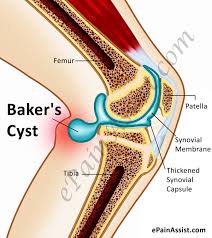
A Baker’s cyst, also known as a Popliteal cyst, is a swelling at the back of the knee joint. Baker’s cysts are fairly common and are associated with chronic swelling within the knee joint. They occur, most frequently, secondary to degenerative disease within the knee joint such as osteoarthritis or meniscal degeneration. The main sign that a Baker’s cyst is present will be a bulge and a feeling of tightness behind the knee.

This may be tender to touch with pain and stiffness often worsening as the knee is straightened after activity or when squatting or kneeling.

Just as a door hinge requires oil to reduce friction and allow smooth movement, similarly, the cartilage and tendons in the knee joint rely on a lubricating fluid called synovial fluid. Synovial fluid circulates around the knee joint and in and out of various fluid sacs called bursae that communicate with the knee joint. Sometimes when a structure within the knee joint is damaged or inflamed too much fluid is produced. If this fluid gets trapped in the popliteal bursae it is called a Baker’s cyst.

If a Baker’s cyst is suspected, the whole knee joint should be assessed thoroughly as treatment involves treatment of the underlying cause. Once the cause has been addressed the swelling generally settles down. Sometimes the bursae might be drained or surgically removed but if the underlying cause of the swelling is not corrected the swelling will just return.

Strengthening exercises for the lower limb can help to improve joint biomechanics and to decrease the load on the knee.

For the fitness of you.

Linda Reilly

Is Your ITB Tight?

February 15, 2018 by Maggi Barnard

Do you sometimes feel a pain in your hip or the outside of your knee after sitting for a while? Maybe when you stand up or when you run? It could be that you have a tight Iliotibial Band (ITB).

The ITB is a thick band of fascia that runs down the outside thigh. It starts at the top of your pelvis, runs over the hip and attaches to the outside of the knee. It also attaches to some of the buttock and hip muscles allowing it to co-ordinate how these muscles work to stabilise the hip and knee. Fluid sacs, called bursae, located at the hip and knee, provide cushioning between the ITB and the bones beneath. If the ITB is tight it can irritate the bursae causing inflammation and pain.

An inflamed bursa at the hip is called a Greater Trochanteric Bursitis and at the knee it is known as ITB Friction syndrome or Runners Knee.

The ITB shortens when sitting for prolonged periods. It can also tighten if the muscle is overworked. This occurs with sudden increases in exercise load or volume or if pelvic control is poor due to weak hip and glute muscles.

Because the ITB is a thick, fibrous band rather than an elastic muscle it requires a longer lighter stretch than most muscles.

The use of a foam roller can also be quite helpful in increasing the flexibility in the ITB. A YouTube search of “foam roller + ITB” will yield videos of how this can be done. For the fitness of you,

Linda R

Improve Your Brain Power

February 15, 2018 by Maggi Barnard

The figures are staggering and there’s little awareness that more than 413,000 people in Australia live with dementia. By 2050 that figure will rise to almost one million.

“Dementia can’t directly be prevented or cured but reducing risk is important,” Alzheimer’s Australia chief executive officer

Maree McCabe says. “Many people are not aware of what they can do to reduce the risk of getting dementia.”

Look after your heart: Look after your heart health by regularly checking your blood pressure, cholesterol and blood sugar levels.

Challenge your brain: Exercising your brain is also important. Find something that involves learning new skills – and keep on learning. Try a new sport, learn a new language, start a course, study for a new qualification at work or take up a new hobby.

Be active: “Being physically active increases blood flow to the brain and this stimulates growth of the brain cells and the connections between them,” Maree says.

Enjoy social activity: Social activity has benefits in a range of areas, including cognitive function. Make time to catch up with family and friends, join a social club or interest group, or volunteer in your community.

Follow a healthy diet: “We need a balanced diet to maintain brain health and function, and some foods may be more directly linked to dementia and reducing your risk,” Maree says.

For more information, call the National Dementia Helpline on 1800 100 500 or visit yourbrainmatters.org.au

By Sarah Marinos

Why Weight?

February 15, 2018 by Maggi Barnard

Maintaining a healthy weight is vitally important to staying healthy as you grow older.

Being overweight can increase the risk of many health problems, including diabetes, heart disease and strokes, high blood pressure, sleep apnoea, kidney disease and osteoarthritis.

Gaining a few kilos during the year may not seem like a big deal. But these kilos can add up over time.

If you are considered to be overweight, losing as little as 5 percent of your body weight may lower your risk for several diseases, including heart disease and type 2 diabetes.

Eating a balanced, nutritious diet and being physically active is the best way to stay healthy and help reduce your risk of disease. To maintain a stable weight, your energy (kilojoule) intake needs to equal the energy you use. If you use more energy than you consume, you will lose weight. On the other hand, if you eat more than you use, you will gain weight.

For some, the answer to losing excess body fat is to make small healthy changes to your eating and exercise habits.  These changes should be things that you can maintain as part of your lifestyle – that way you will lose weight and keep it off.

However, some people may need help to lose those extra kilos and the team at Flannery’s Pharmacy can help you with information, advice and a range of meal replacement and weight loss products specifically formulated to help you lose weight.

If you would like help to lose weight, call in to Flannery’s Pharmacy for information and advice and let us help you on your weight loss journey.

Quit Smoking Now

January 24, 2018 by Maggi Barnard


Want to quit smoking? Have you tried before with little or no success?

If this sounds familiar you might like to take advantage of the offer of free nicotine replacement therapy and extra support to help you quit.

Tobacco Treatment Specialist, Maria Willis, from the Forbes Health Service will be instore at Flannery’s and Life Pharmacies during February and March to help people to quit smoking. Maria is a Nurse Practitioner who assists community members who have diabetes, respiratory and heart conditions.

Community members can make an appointment to see Maria at either pharmacy.

During the appointment smoking habits will be assessed and free nicotine replacement therapy will be offered. Maria will also be able to assess the patients concerns and provide helpful information and advice on how to quit smoking.

“It is also important to remember your GP, pharmacists and QuitLine can provide support to quit,” said Maria.

“Smoking is more addictive than heroin and cocaine so understandably it is not easy to quit,” said Maria. “However, quitting smoking is one of the most important things you can do for your health and it is never too late to quit, increase your life expectancy and improve your quality of life.”

“There is no safe level of smoking. Even the occasional cigarette is doing you harm.”

To book an appointment to begin your journey to quit smoking, call Flannery’s Pharmacy on 6852 1111 or Life Pharmacy on 6852 2001.

Don’t miss this great opportunity to get all the help you need to quit for life!


  • « Previous Page
  • 1
  • …
  • 26
  • 27
  • 28
  • 29
  • 30
  • …
  • 32
  • Next Page »

Click here to download the recent issue (186) of The Forbes & Parkes Phoenix (2.1MB PDF) – 24th April 2026

SEARCH THE PHOENIX

STAY CONNECTED

The Forbes Phoenix would like to thank you, our Facebook friends, for your continued support and readership!

Recent Articles

  • Snippets… April 23, 2026
  • Mayoral Notes April 23, 2026
  • Four Days Of Double Demerits This Anzac Day Long Weekend April 23, 2026
  • Forbes Marks Anzac Day With Services And Special Town Hall Tribute April 23, 2026
  • Celebrating Our Stories, Places And People April 23, 2026

Phoenix Office 7/113-127 Rankin Street, Forbes NSW 2871

Editor 0432 337 278
editor@forbesphoenix.com.au

Sales 0432 337 278
sales@forbesphoenix.com.au

View our Privacy Policy. View our Conflict Resolution Process. View our Ethics and Complaints Policy. Want to advertise with us? Information on our Community Promotions.

We are always looking for new articles of interest to the local community.

Please feel free to submit an article for possible inclusion in a future issue.

To submit an article, click here to use our online article submission form.

Subscribe

* indicates required

Copyright © 2026 · Magazine Pro Theme On Genesis Framework · WordPress · Log in