• Home
  • Articles
    • Front Page
    • General Interest
    • Snippets
    • Letters to the Editor
    • Council Comments
  • Special Interests
  • Our Community
    • Our People
    • Question of the Week
    • Jobs in the Central West
    • Be Seen
    • What’s On
    • What’s Hot
  • Features
    • Women in Business
    • Rural Round Up
    • My Place
    • Loving Local Living
    • Wellness Wise
    • Just a Short Drive
    • Real Estate
  • Sports
    • Bowls
    • Cricket
    • Equestrian
    • Footy Tips
    • Golf
    • Netball
    • Rugby League
    • Rugby Union
    • Soccer
    • Touch Football
  • Classifieds
  • Competitions
  • Contact Us
    • Contact Page
    • Advertise with us
    • Testimonials
    • Submit an Article
    • Subscribe to the Forbes Phoenix

Forbes Phoenix

Felix Rams 22nd Annual On-Property Sale

August 21, 2020 by Maggi Barnard

Felix Rams focuses on producing efficient and profitable prime lambs by breeding high performance, structurally sound rams for efficient prime lamb enterprises. Their commitment to collecting good accurate performance data is in the DNA and is embedded as the fundamental approach to the way they breed sheep.

In the world of big data, 27,000 lambs weighed within 12 hours of birth, 22,000 weaning weights, almost 18,500 scans with weights for postweaning fat and muscle and 4,400 individual worm egg counts is a lot of data. This is the performance data that influences the ram selection and the accuracy of the Sheep Genetics Lambplan asbvs on the rams you buy.

Felix Rams are selected for quick early growth and maturity, not maximum adult ram size. Most of the selection is done at 6.5 to 7 months, reflecting the age most lambs are sold. At Felix it is all about the lambs. Felix Rams selects for early maturity to efficiently produce a 22-28 kg lamb. Early maturity also means your suckers have the best chance of hitting the target year in year out, while attention to the “right” amount of fat means that you will almost always have finish on your lambs at market weights.

Despite the tough start, the 2019 drop rams have transformed with the improved season. Felix Rams selection are for rams that perform on pasture and under commercial conditions. This year’s sale rams are paddock grown and finished and are not pumped up or grown out on a grain feeder.

Felix Rams will offer around 140 Poll Dorset and 50 White Suffolk rams at their 22nd annual on-property sale at Greenethorpe on 1 September at 1pm. Catalogues are available at www.felixrams.com.au. Email felixrams@gmail.com or call Rodney 0417 499 204, Isaac 0437 493 407 or the selling agents, Allan Gray and Co Cowra 02 6342 2377.

National Approach To Managing Wild Dog Scourge

July 3, 2020 by Maggi Barnard

Image credit: https://www.agric.wa.gov.au/

Australia’s new blueprint for humane, best practice wild dog management officially took effect from 1 July.

Agriculture, Drought and Emergency Management Minister David Littleproud praised the way government and industry stakeholders collaborated on the new National Wild Dog Action Plan.

“Wild dogs are terribly destructive pests, costing farmers conservatively upwards of $89 million a year in lost production and control costs,” David said. “They can decimate livestock, tearing down sheep and goats at will, and in doing so, can hurt rural and regional economies because of the destruction they wreak and anxiety they cause.”

Having a clear, coordinated and borderless national plan to guide farmers and other stakeholders on the best strategies and safest tools for livestock and biodiversity protection is critical for rural and regional communities as they recover from COVID-19, bushfires and drought.

David applauded the way producers, peak farming bodies, governments and research and development corporations came together to ensure control measures are evidence-based and best practice. “Wild dog management is an Australian Government priority, with over $54 million invested in wild dog management since 2014-15, including recent wild dog fencing commitments in South Australia and Western Australia,” he said.

“The National Wild Dog Action Plan has already proved an exemplar in the way we should be approaching Australian predator management.”

The National Biosecurity Committee endorsed the National Wild Dog Action Plan 2020-2030 as the national plan for the co-ordinated management of wild dogs on 11 March 2020.

Delay The Spray-Clethodim Advice

June 26, 2020 by Maggi Barnard

Grain growers are reminded they should avoid spraying annual ryegrass with clethodim herbicide when frost is forecast.

Weed control experts are advising growers not to spray clethodim two to three days before or after a frost event due to the impact on efficiency. The poor performance of clethodim on annual ryegrass, a weed becoming increasingly resistant to clethodim, can be associated with cold and frosty conditions.

University of Adelaide Associate Professor in weed and crop ecology, Dr Gurjeet Gill, says frosty conditions make it even harder to control annual ryegrass when clethodim resistance is present in the population.

“Growers are advised to carefully review weather forecasts for their district and spray clethodim when cloud cover is present and the risk of frost occurrence is low,” Gurjeet says.

Clethodim resistance has been slowly increasing in the northern region with current testing indicating resistance through New South Wales is less than 10 per cent.

This message is particularly pertinent to Forbes, which is prone to frost at this time of year, when many canola and pulse crops are likely to be sprayed for ryegrass control.

New Restrictions From 15 June At CWLE

June 19, 2020 by Maggi Barnard

The Central West Livestock Exchange (CWLE) is moving into Stage 2 of the recovery from COVID-19, with the allowance of agents, vendors, restockers and contractors on site while business is being conducted from 15 June.

“The Saleyards are not open to the general public, if you are not conducting direct business here please do not come,” says Forbes Shire Council’s General Manager, Steve Loane, who also advised that “we require all to follow some simple guidelines when attending the facility. Please fill out the attendance form before turning up at the yards. Failing to do so only results in long queues at the gate, which nobody appreciates. This form can be found on our website and the agents also have access to it.

“We know how important it is for our farming community to have a chance to catch up with fellow stock men and women and talk about their trials and tribulations. This place is a common meeting ground and everyone’s mental health needs considering,” Steve said.

For further information please contact Central West Livestock Exchange manager Cassi Walmsley on 6850 2300.

Farmers’ Flexibility Put To The Test Again

June 12, 2020 by Maggi Barnard

Callen Thompson from the Central West Local Land Services has some great advice to help farmers adapt to recent change.

Following earlier rainfall, warmer temperatures, and generally lower numbers of stock across the region some producers are now considering silage as an option for storing excess feed.

Central West Local Land Services mixed farming advisor Callen Thompson said while excess feed was a good problem to have there were a number of things to keep in mind before trying silage for the first time.

“Particularly if they have sown grazing crops or their cereal crops have started to run up growers are looking at their options to conserve this fodder for future use or create a saleable product to help with cash flow,” Callen said.

“Silage can be a great fodder source used to fill gaps in feed supply,” he said. The growth stage of the crop, what the silage will be used for and how it will be made were all important considerations for producers.

If cut at the right time, silage can retain much of the crops fodder quality, unlike hay which decreases in quality through the hay making process. “At this time of year you need to know if you will be able to dry the cut material quick enough to ensure feed quality, you may need to wait until daytime temperatures start to increase,” Callen said.

The decision on whether to produce bales or chopped silage would also depend on how much would be used at a time and whether it would be used on the farm or sold. Bales can be a better option if you only want to feed out small amounts at a time and wrapped bales can be sold off farm more easily.

For more information on considerations for making silage or to be notified of upcoming silage workshops contact Central West Local Land Services on 1300 795 299.

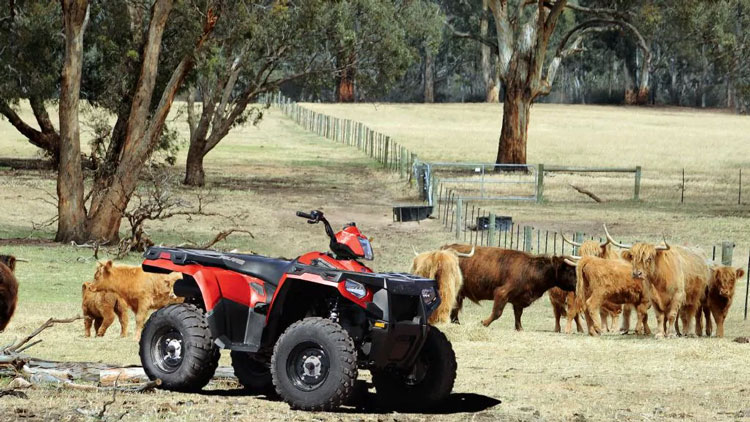
Polaris Ceases Quad Bike Range

March 6, 2020 by Maggi Barnard

Polaris will not be selling their quad bike range (ride on ATV’s) from October this year due to changes in government standards for quad bikes.

As a retailer of Polaris, Forbes Small Engines have informed customers they will continue to stock all Polaris quad bike models, however some models have already sold out.

Paul and Maree Westcott have been selling quad bikes for many years, but noticed the market had been steadily moving towards the side by side ORV models.

“We still have many customers that use ATV’s/quad bikes and this is why we will continue to stock Polaris quad bike models for as long as they are available.”

Managing Director of Polaris Australia & New Zealand, Alan Collins said, “Over recent years the Australian off-road vehicle market has experienced record levels of transference as farmers transition en masse from quad bikes, to Side by Side vehicles, Polaris has led this transition with its industry leading range of 30 vehicles with ROPS, and the market shift has been helped along in no small part by the safety rebates offered by SafeWork NSW and WorkSafe Victoria.”

Polaris maintains its view that the market itself would end up signalling the end for quad bikes over coming years anyway through sheer lack of demand driven by the availability, benefits and range of side by side vehicles.

Polaris has committed to continuing to support all ATV/quad bikes with parts, accessories and warranty support for the next decade.

If you are an avid user of quad bikes and Polaris in particular, now is the time to get in touch with the Forbes Small Engines team before it’s too late and stock has run out.

RDA Central West Doubles Down On Drought Focus

March 6, 2020 by Maggi Barnard

Sheep finding food on travelling stock route east of Grenfell.

Regional Development Australia (RDA) Central West is calling on all levels of government, business and the community to remain focused on the ongoing impacts of the drought across the Central West. This position was formally reiterated at the most recent RDA Central West board meeting.

Convening in Bathurst last month, the board of RDA moved a motion to ensure supporting the communities impacted by drought and supporting the provision of key services was the priority focus of the organisation for 2020.

RDA Central West Chair, Christine Weston said that recent rains in some regions have been most welcome, but the recovery from the drought is a long and ongoing process.

“As a farmer I have directly been impacted by this debilitating drought on a daily basis. It hammers output, productivity and confidence.”

“The recent rain has provided a temporary boost for some communities, but we are nowhere close to the road to recovery. This is why drought support and recovery is the key priority for RDA Central West in 2020,” said Christine.

There continues to be sad drought-affected consequences, such as the closure of the Trundle grocery store and farmers across the region still spending thousands a day on stock feed, the economic and social impact on our communities has been immense.”

Christine took the opportunity to remind residents to shop local and support their community when they can, and encourage family and friends to stay, shop and visit in the Central West.

“Backing local communities and local businesses drives jobs, boosts confidence, and by visiting our region it is a simple way to show your support, and say we are here and we want to help,” said Christine.

RDA Central West acknowledges the efforts and drought response measures already announced by both the State and Federal Government.

Felix Rams Sale Results

September 12, 2019 by Maggi Barnard

It was an outstanding day at Felix Rams sale last week, with 51 registered bidders and 191 rams on offer. The older Poll Dorset rams sold to a top of $3,050 and averaged $1,419, with a clearance of 96%. The spring drop Poll Dorset rams sold to a top of $6,200 and averaged $1,532, with a clearance of 77.7%. The White Suffolk rams sold to a top of $5,000 and averaged $1,144 and had a clearance of 81.8%. Credit must go to Rodney, Liz and Isaac Watt for their breeding and preparation of these rams, each one was exceptional.

Jemalong Wool Weekly Market Update

September 12, 2019 by Maggi Barnard

After a month of severe losses, this week’s market showed signs of a recovery, with exporters reporting that sales had been made, which finally gave the market a base.

The first day of selling saw further losses, resulting in the NRI shedding a further 27 cents, however during the last hour of selling (in the West) there was a noticeable change of tone, and fierce competition started to push prices back in a positive direction. The positive sentiment carried into the second selling day, and prices finally started to increase.

The MPGs generally rose by 30-40 cents, pushing the NRI up by 30 cents, closing the week 3 cents in the green at 1408.

The carding market also recorded a positive result for the series, as the limited lots on offer came under strong demand pushing them up by 10-30 cents.

The crossbred market was not forgotten with 26 to 28 microns rising by 5-10 cents.

27,923 bales are currently rostered for sale next week.

Source: AWEX

Warning For Feral Pigs

September 12, 2019 by Maggi Barnard

With many farmers across the Central West hand-feeding livestock, Local Land Services is reminding landholders that feral pigs will also help themselves to stock feed.

Invasive Species Team Leader Nigel Boyce said landholders are seeing an increase in feral pigs around feeding and water points, which can undermine hand-feeding programs and spread disease.

“The current drought conditions are seeing feral pigs seeking out feed and water from places they would normally avoid,“ Mr Boyce said. “They are proving quite resourceful in accessing feeders and other feeding points, and cohabitating with livestock to do so.”

Feral pigs joining livestock at feed and water points also greatly increases the chance of spreading disease. “Feral pigs can carry diseases such as leptospirosis and brucellosis, which can be spread to both livestock and humans with significant health implications,” Mr Boyce said.

While the situation is not ideal, it presents an opportunity to carry out trapping, baiting or a combination of both to effectively reduce the impact caused on agricultural production and the environment.

  • « Previous Page
  • 1
  • …
  • 12
  • 13
  • 14
  • 15
  • 16
  • …
  • 28
  • Next Page »

Click here to download the recent issue (186) of The Forbes & Parkes Phoenix (2.1MB PDF) – 24th April 2026

SEARCH THE PHOENIX

STAY CONNECTED

The Forbes Phoenix would like to thank you, our Facebook friends, for your continued support and readership!

Recent Articles

  • Snippets… April 23, 2026
  • Mayoral Notes April 23, 2026
  • Four Days Of Double Demerits This Anzac Day Long Weekend April 23, 2026
  • Forbes Marks Anzac Day With Services And Special Town Hall Tribute April 23, 2026
  • Celebrating Our Stories, Places And People April 23, 2026

Phoenix Office 7/113-127 Rankin Street, Forbes NSW 2871

Editor 0432 337 278
editor@forbesphoenix.com.au

Sales 0432 337 278
sales@forbesphoenix.com.au

View our Privacy Policy. View our Conflict Resolution Process. View our Ethics and Complaints Policy. Want to advertise with us? Information on our Community Promotions.

We are always looking for new articles of interest to the local community.

Please feel free to submit an article for possible inclusion in a future issue.

To submit an article, click here to use our online article submission form.

Subscribe

* indicates required

Copyright © 2026 · Magazine Pro Theme On Genesis Framework · WordPress · Log in