• Home
  • Articles
    • Front Page
    • General Interest
    • Snippets
    • Letters to the Editor
    • Council Comments
  • Special Interests
  • Our Community
    • Our People
    • Question of the Week
    • Jobs in the Central West
    • Be Seen
    • What’s On
    • What’s Hot
  • Features
    • Women in Business
    • Rural Round Up
    • My Place
    • Loving Local Living
    • Wellness Wise
    • Just a Short Drive
    • Real Estate
  • Sports
    • Bowls
    • Cricket
    • Equestrian
    • Footy Tips
    • Golf
    • Netball
    • Rugby League
    • Rugby Union
    • Soccer
    • Touch Football
  • Classifieds
  • Competitions
  • Contact Us
    • Contact Page
    • Advertise with us
    • Testimonials
    • Submit an Article
    • Subscribe to the Forbes Phoenix

Forbes Phoenix

$100 Million For Farmers Impacted By Mice

June 18, 2021 by Maggi Barnard

FIGHT AGAINST MICE: The NSW Government has invested heavily in the eradication of mice. Pic courtesy of Stephen Michael Barnett.

NSW Nationals Upper House MP, Sam Farraway, is encouraging primary producers experiencing financial hardship due to the mice plague to apply for rebates for the purchase of the critical mouse plague control chemical zinc phosphide.

Mr Farraway said this is part of the NSW Nationals commitment to supporting primary producers in Central West who have been battling with the devastating wave of mice in regional NSW.

“This new funding will offer primary producers in Central West financial relief by providing a rebate of 50 percent on zinc phosphide purchases, up to $10,000, to help cash flow and confidence to place advance orders on zinc phosphide ahead of spring,” Mr Farraway said.

“Communities in the Central West have done it tough off the back of drought, bush-fires, floods and COVID-19 and the last thing we needed was these vermin terrorizing us in our sleep and destroying crops.

“The NSW Nationals are building a safer and stronger regional NSW and these rebates are part of our commitment to supporting our agriculture sector which gives so much to this state.”

NSW Nationals Leader and Deputy Premier, John Barilaro said the NSW Government was working with manufacturers to shore up supplies of zinc phosphide to ensure the State’s farmers are prepared to stamp out a possible spring surge in the mouse population.

“When the mouse bait and treated grain programs were announced I said there would be more support to come and today I’m pleased to confirm we will extend the program to include primary producer rebates for zinc phosphide,” Mr Barilaro said.

“We will make sure any baits produced with zinc phosphide are earmarked for sale to NSW producers first, and we will continue to work to connect manufacturers with Commonwealth support such as the International Freight Assistance Mechanism.”


Forbes New Grain Treatment Site

May 28, 2021 by Maggi Barnard

Forbes is among 20 regional locations across NSW where the Berajiklian Coalition Government will establish grain treatment sites to help combat the ongoing mouse plague.

“Pending approval, sites will also be set up at other western NSW areas including Nyngan, Condobolin, Coonabarabran and Coonamble, while Merriwa and Walgett are also on the list,” said NSW Agriculture Minister Adam Marshall said.

Mr Marshall also confirmed his hometown of Gunnedah, Dubbo, Holbrook, Inverell, Mudgee, Jerilderie, Narrandera, Scone, Tamworth, Moree, Narrabri, Wagga Wagga and Warialda as the other areas where sites will be situated.

“Instead of the initially suggested ten sites, we’ve now made our grain treatment even easier for farmers to access and doubled that number to 20,” Minister Marshall said.

“These mice are a scourge on our regional communities, but these 20 sites will be strategically located throughout the state’s most affected areas, from Warialda to Wagga, and Condobolin to Scone, to help ease the burden on our farmers,” he said.

Farmers can register for grain treatment through their nearest Local Land Service office, with sites to operate in rotation and by appointment to ensure safe chemical handling and access for staff and customers.

Mr Marshall said the treatment sites would complement the measures already put in place by the NSW Government to support landholders. “Our workshops educating farmers on best practice to manage mice continue to be well subscribed and well received,” Mr Marshall said.

The free grain treatment is part of the NSW Government’s $50 million support package to manage the impacts on regional communities, which also includes bait rebates for households and small businesses, community workshops and targeted pest research.

Nothing Mice About This Plague

February 19, 2021 by Maggi Barnard

It’s been compared to the mice plague of 2011 that cost farmers $200 million.

Now, nearly a decade on, everyone is gearing up for the next wave and with all the welcomed rain comes mice, who breed and feed every 10-21 days and can produce up to 500 offspring in a season.

Information via the Central West Local Land Services website and Senior Land Services Officer for Mixed Farming, Callen Thompson has some tips for farmers explaining that, “Producers also need to be mindful that although mice will normally only travel 3-5 metres to forage for food, when numbers are high, they will actively travel.”

“So, if you do decide to treat paddocks early, you will need to at least budget on regular perimeter bating to keep them out of your paddocks.”

“The reason mouse numbers are high this year is because of the positive season. There is plenty of grass and crop seed on the ground to eat and a lot of grass and stubble that they can use for habitat,” Thompson said via the website.

For more information, contact Central West Local Land Services.

First Store Sale In Three Years For Forbes

February 19, 2021 by Maggi Barnard

Raring to go: Libby Hufton, StockLive Manager.

Forbes’ Central West Livestock Exchange (CWLE) will hold its first Store Sale in three years this month, with a strong livestock market and the capacity for online bidding via StockLive driving the decision. Cassi Walmsley, Manger Livestock Exchange at Forbes Shire Council, said that while the drought had led to the temporary halt of Store Sales, Council was encouraged by the strong January results across the board and the performance of online bidding platforms like StockLive.

“We’ve been planning to reinvent our Store Sales for some time and have been monitoring the market to see when the time was right. We’ve seen the strong demand and prices generated by StockLive, with online bidders lifting the price, and we see the time is right to harness that momentum,” she said.

The Store Sale will start at 10am on Friday, 19 February. Pre-sale catalogues and marketing will provide buyers with the opportunity to pre-plan, which is a proven component of StockLive’s ability to deliver successful outcomes for their partner saleyards. StockLive Manager Libby Hufton said they were thrilled to be supporting CWLE and the return of their Store Sales.

“StockLive continues to deliver great results as witnessed throughout the January weaner sales with the robust market boosted by the ability of a wider pool of buyers to bid online. This delivers on our goal of enabling the saleyard industry to expand market access and we’re looking forward to adding CWLE to the growing network of StockLive enabled yards.

“For anyone new to StockLive, the process is simple – you visit the StockLive website and register your details to become an active bidder on your selected sales.”

To register to bid or access the pre-sale catalogue, buyers should head to www.stocklive.com.au

Improving Drought Resistance

February 5, 2021 by Maggi Barnard

The Australian Government is investing $10 million through the Climate Services for Agriculture Program to help farm businesses increase drought and climate resilience.

Minister for Agriculture, Drought and Emergency Management, David Littleproud, said the program was funded through the $5 billion Future Drought Fund and would provide farmers with access to trusted and relevant information on national and regional climate data.

“We are the first government to look to the future to prepare for the next drought which is why we have established the $5 billion Future Drought Fund,” David said.

“The Climate Services for Agriculture Program will complement seasonal forecasts and climate guides that are currently available through BOM by providing detailed regional information about future drought and climate risks and inform management actions to address vulnerabilities and prepare for future impacts.

“CSIRO and BOM will engage the agricultural sector to determine the type of climate information that is most useful to their businesses and test in four pilot regions to ensure the decision support tools to meet their needs.”

“The pilot regions will be identified in early 2021 and will include a range of climatic regions and agricultural sectors.”

The Climate Services for Agriculture Program is one of the foundational programs announced under the Australian Government’s $5 billion Future Drought Fund on 1 July 2020. The Australian Government continues to support farmers and regional businesses through tough times.

For more information go to: www.agriculture.gov.au/ag-farm-food/drought/future-drought-fund#climate-services-for-agriculture-program.

More Workers To Support Farmers

January 22, 2021 by Maggi Barnard

While the Morrison Government is changing visa conditions to provide more workers to farmers struggling to find the extra hands during harvest season, some of the new conditions may undermine the basic principles of Australian democracy and cultural values by refusing to give a ‘fair go’ to those at risk of returning to countries with fatally failing healthcare systems.

Australia’s fruit picking sector has faced criticism over conditions and farms in and around the Central West are not exempt from reports of unscrupulous treatment of workers. In Queensland, Belgian backpacker Olivier Caramin died from heat stress while picking fruit, his employer was fined for breaking labour laws but avoided conviction.

According to Minister for Immigration, Citizenship, Migrant Services and Multicultural Affairs Alex Hawke, under the changes, temporary visa holders are more likely to be granted the COVID-19 Pandemic Event visa, so long as they work in the agriculture sector.

While this incentive may deliver much needed workers out West, the coercive nature of this regulatory change, that makes temporary visa holders choose between the safety of the COVID-19 visa and another round of hard labour, is a concern which warrants further enquiries.

Central West Livestock Exchange Receives Drought Stimulus Funding For Shade Sails

December 18, 2020 by Maggi Barnard

The CWLE. Image Credit: https://www.forbes.nsw.gov.au/

Forbes Shire Council has received $85,000 for shading at the Central West Livestock Exchange (CWLE) sheep yards from the NSW Government Local Drought Stimulus Program. The much-needed sails have recently been installed.

“This installation is all part of the plan for the extension of the CWLE, with a further $3.4 million spent on expanding the yards to include a multi-species yards undercover early this year,” says Forbes Shire Council General Manager, Steve Loane. “This area was in need of shade given the extreme heat we experience here on sale days during summer.”

“Animal welfare is always front of mind for Council and the shade makes a considerable difference to not only the animals but the people on the ground as well. The shade sails will ensure stock is kept in a stable condition, ensuring they are fit for transport and fit for consumption,” said Steve.

Forbes Shire Council are the current holders of the ALMA Animal Welfare Award which they received in 2019, for their commitment to best practice in animal welfare at the Central West Livestock Exchange.

“The sails amongst all the other improvements taken place at the CWLE, are simply amazing,” says Forbes Shire Council Mayor, Phyllis Miller. “With over 1.4 million sheep traded annually at this site, we needed to make sure animal and human safety was a key driver. We are very grateful to the State Government for the grant funding to enable us to do this incredible work. These farmers are the backbone of our community, we need to look after them.”

The CWLE is a state of the art facility which was purpose-built for the selling of quality cattle, sheep and pigs. The facility was built in 2005 and is a key economic driver for the Forbes Shire.

Stay On Label And Know Your Market Before Using Desiccants

November 6, 2020 by Maggi Barnard

Cereal, pulse and oilseed growers are being reminded to adhere to label directions for herbicides used as a desiccant and understand their target market requirements this harvest to avoid issues with chemical residues.

It is critical growers are aware that maximum residue limits (MRLs) in Australia could differ from MRLs in international grain markets such as the European Union, according to Grains Research and Development Corporation (GRDC) Manager Chemical Regulation, Gordon Cumming.

“Late season rain has created harvest issues across areas of Australia, and growers are now carefully considering their options when it comes to managing their crop and maximising yield, weed control and grain quality to achieve the best profit margins,” Gordon said.

“However, where chemical desiccants, used to speed up the crop ripening process, are being considered there is the potential for chemical residues to arise that may exceed certain market requirements, even when used in accordance with the label directions.”

“For example, for durum, the Australian MRL for diquat is 2 milligrams/kilogram, whereas in a major potential market for Australian durum, the European Union, there is a significantly lower MRL of 0.02mg/kg.”

Chair of the National Working Party on Grain Protection (NWPGP), Gerard McMullen, said all markets had strict limits for chemical residues and growers and marketers needed to work together to ensure grain was compliant with market requirements.

“Marketers need to closely monitor market requirements and provide advice to growers. Non-compliance can lead to the rejection of shipments in export markets and create ongoing market access issues,” Gerard said.

Differences in regulations make grain exporters wary and many were reluctant to consider buying grain from crops treated with certain chemicals, such as diquat on durum.

Growers have a legal obligation to follow label directions and understand the needs of their buyers. Exporters also have a role to play. Grain should not be exported unless the residue status is known and complies with market requirements.

The GRDC has produced fact sheets on desiccants for use by crop type. For more information go to https://grdc.com.au/resources-and-publications/all-publications/factsheets/2020/preharvest-herbicide-use-fact-sheet.

Keeping Roads Safe This Harvest

November 6, 2020 by Maggi Barnard

Melanie Suitor and Peter Nixon, Manager of Forbes Machinery Centre, with an auger.

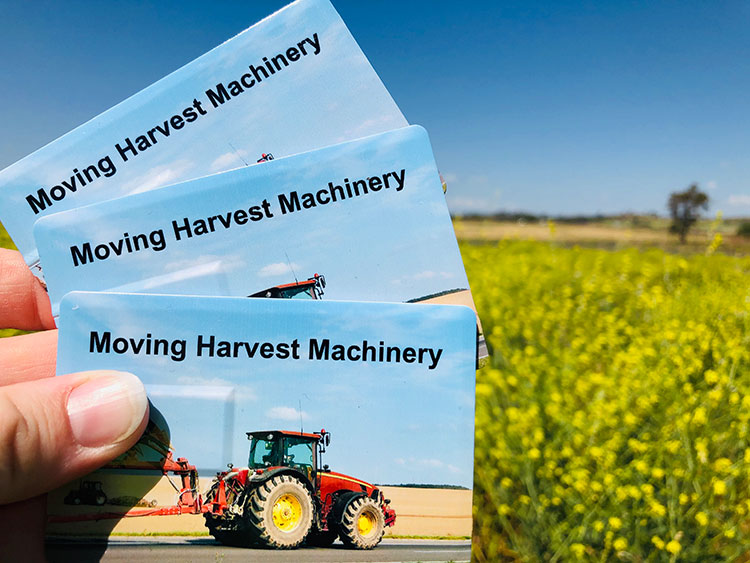
Agricultural machinery owners and operators are invited to get road ready ahead of the 2020 harvest season, by picking up a free Moving Harvest Machinery USB from all agricultural machinery retailers and rural supply stores in the Parkes, Forbes, and Lachlan Shire areas. The USBs are also available at the Councils Administration Offices.

The ‘Moving Harvest Machinery’ USBs contain all of the relevant notices for safely and legally moving agricultural machinery and combinations on the road along with other useful harvest safety information.

Parkes, Forbes and Lachlan Shire Councils Road Safety and Injury Prevention Officer, Melanie Suitor, says it is imperative that all operators be aware of their responsibilities whilst operating over dimensional vehicles this harvest.

“For the first time in a few years it is looking like it’s going to be a great harvest, which means lots of extra truck movements and agricultural machinery will be using local roads.”

“Safety and compliance during harvest is very important. Operators need to be aware of their responsibilities and ensure that all warning devices and travel requirements are adhered to,” Melanie said.

Regulations do change and this USB will help to ensure that people have up to date information.

“We provide these handy credit card style USBs every harvest. It has been updated with the most current notices and provides other relevant information such as load restraint, chain of responsibility and the Harvesting Fire Safety Guide, to name a few. There is also a live link document, which provides the web address for the attachments on the USB. It is advisable to regularly check the National Heavy Vehicle Regulators website www.nhvr.gov.au for updated notices and/or changes to operating conditions,” Melanie said.

This year there are 1,000 USB devices available.

Be Harvest Ready

October 23, 2020 by Maggi Barnard

The recent Be Road Ready For Harvest Virtual Field Day, held via Zoom, was a sellout. More than 90 people registered for the event with a further 20 people signing up to the waitlist.

Attendees were a mixture of farmers, contract harvesters, transport companies, agricultural machinery retailers, government agencies, council staff and relevant associations.

The event was supported by the National Heavy Vehicle Regulator, Transport for NSW, NSW Police, NSW Farmers, WFI and Parkes, Forbes and Lachlan Shire Councils.

It provided information about the current regulations for safely and legally moving agricultural vehicles and combinations on the road.

Parkes, Forbes and Lachlan Shire Councils’ Road Safety and Injury Prevention Officer, Melanie Suitor, said it was great to see strong numbers for the Virtual Field Day, especially as the region is expecting a good harvest for the first time in a number of years.

“Unfortunately due to the current COVID restrictions we weren’t able to hold our face to face event at the Central West Livestock Exchange at Forbes, but it was very pleasing to see many of the regulars join us for the online event. There were also a large number of first-time attendees from right across the Central West.”

“Safety and compliance during harvest is very important. Operators need to be aware of their responsibilities and ensure that during harvest all warning devices and travel requirements are adhered to.”

“Regulations are constantly changing and events like this are important to ensure people are up to date on what’s required before the upcoming harvest period,” Melanie said.

The Virtual Field Day was recorded and can be accessed on the Forbes Shire Council’s YouTube channel.

  • « Previous Page
  • 1
  • …
  • 10
  • 11
  • 12
  • 13
  • 14
  • …
  • 27
  • Next Page »

Click here to download the recent issue (176) of The Forbes & Parkes Phoenix (1.6MB PDF) – 13th February 2026

SEARCH THE PHOENIX

STAY CONNECTED

The Forbes Phoenix would like to thank you, our Facebook friends, for your continued support and readership!

Recent Articles

  • A $7.6 Million Boost For Forbes Future Water Security February 12, 2026
  • Mayoral Notes February 12, 2026
  • Snippets… February 12, 2026
  • Indigenous Storytellers Scholarship Returns February 12, 2026
  • Meet Indigenous Chef Mindy Woods At Forbes Crop Swap February 12, 2026

Phoenix Office 7/113-127 Rankin Street, Forbes NSW 2871

Editor 0432 337 278
editor@forbesphoenix.com.au

Sales 0432 337 278
sales@forbesphoenix.com.au

View our Privacy Policy. View our Conflict Resolution Process. View our Ethics and Complaints Policy. Want to advertise with us? Information on our Community Promotions.

We are always looking for new articles of interest to the local community.

Please feel free to submit an article for possible inclusion in a future issue.

To submit an article, click here to use our online article submission form.

Subscribe

* indicates required

Copyright © 2026 · Magazine Pro Theme On Genesis Framework · WordPress · Log in