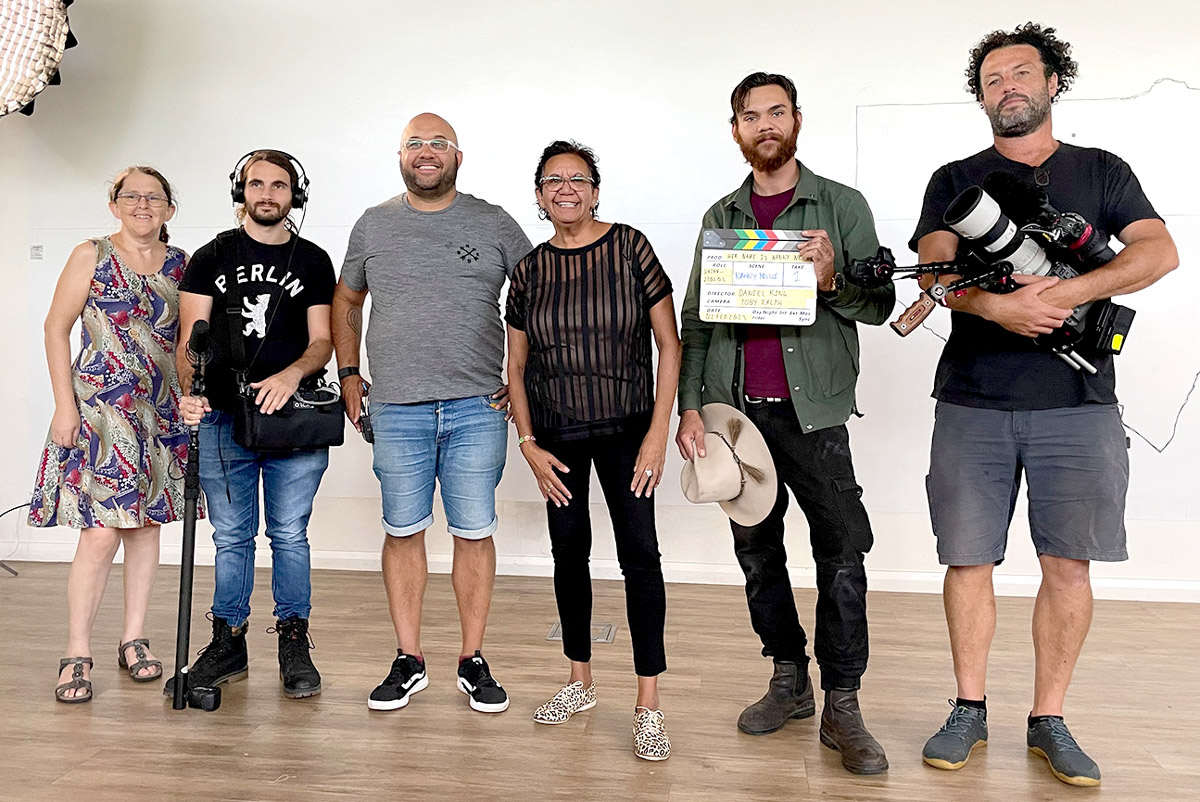
ACTION…On set during filming of the documentary, “Her Name Is Nanny Nelly”, are production assistant Lisa Ramsay, sound crew, director Daniel King, local indigenous artist Irene Walker, production assistant Conor Baillie and camera crew.
Parkes will feature in a documentary about the family history of Peak Hill resident, and well-known indigenous artist, Irene Walker.
Back in 2006, Irene was researching her family history. Upon entering her great grandmothers name, Nelly Bungil (Nanny Nelly) in an online search, she discovered photographs of her great grandmother that had been made into a sculpture.
Irene was not aware of any stories about a statue being made of Nanny Nelly, however, it turned out there were family members who did know, and one of them was Irene’s brother Arthur Ridgeway.
Irene’s eldest son, Daniel King recalls a trip he made with his uncle in 2001, where he first saw the statue.
“We basically went down to the vaults of the Australian Museum and into a room. There was this white sheet over a lifesize figure, we took the sheet off and there was my great-great grandmother,” said Daniel.
“The statue was absolutely lifelike, it was literally like she was standing there.” Daniel also sadly recalls seeing the the pain in her eyes.
More than 20 years after first seeing the statue of Nanny Nelly, Daniel has been awarded funding from the Adelaide Film Festival to produce a documentary about his great-great grandmother. The feature length documentary will will premiere at the 2023 Adelaide Film Festival, and air on NITV.
In 1996 Nanny Nelly’s daughter, Victoria Walker (Nanny Kempsey) was walking through the Australian Museum when she saw the statue and recognised that it was actually her mother.
Nanny Kempsey was part of the stolen generation, at the age of eight she was taken into custody by the Aboriginal Protection Board and sent to Cootamundra Girls School. She didn’t see her mother again until she was 17 years old when she received notification that her mother, Nanny Nelly was dying and had requested to see her. She stayed by her mothers side until her passing.
Upon seeing her mothers unclothed statue on display in the Australian Museum, Nanny Kempsey wrote to the museum to have the statue removed from display. However, after consulting with family members, she then wrote to the museum again, allowing them to keep the statue, specifying that it could be put back on display under the condition that they clothed Nanny Nelly’s statue, identified Nanny Nelly and told her story.
Irene Walker first saw the Nanny Nelly statue on a trip with Daniel in 2018, when it had been relocated to Penrith. Knowing that Nanny Nelly was unclothed, she requested the museum place a sheet around her.
Irene described seeing her great grandmother as an amazing experience. “It was the pinnacle moment for me, it was like looking at a real person,” said Irene. She has visited Nanny Nelly several times since this and describes it as wonderful.
The Australian Museum has committed $150,000 to the restoration of not only Nanny Nelly’s statue, but of two other statues that were commissioned at the same time.
The three statues of a young boy, an older male and a woman, were commissioned in 1938 as a way of preserving an image of full blooded Aboriginals who were believed to be a dying race, when the census revealed a decline in the population.
Nanny Nelly’s family are retracing her steps in the feature length documentary titled “Her Name is Nanny Nelly”. Part of that journey is to find the families of the other two statue subjects, the older man, Jimmy Clemence and the young boy, Harold Marsh.
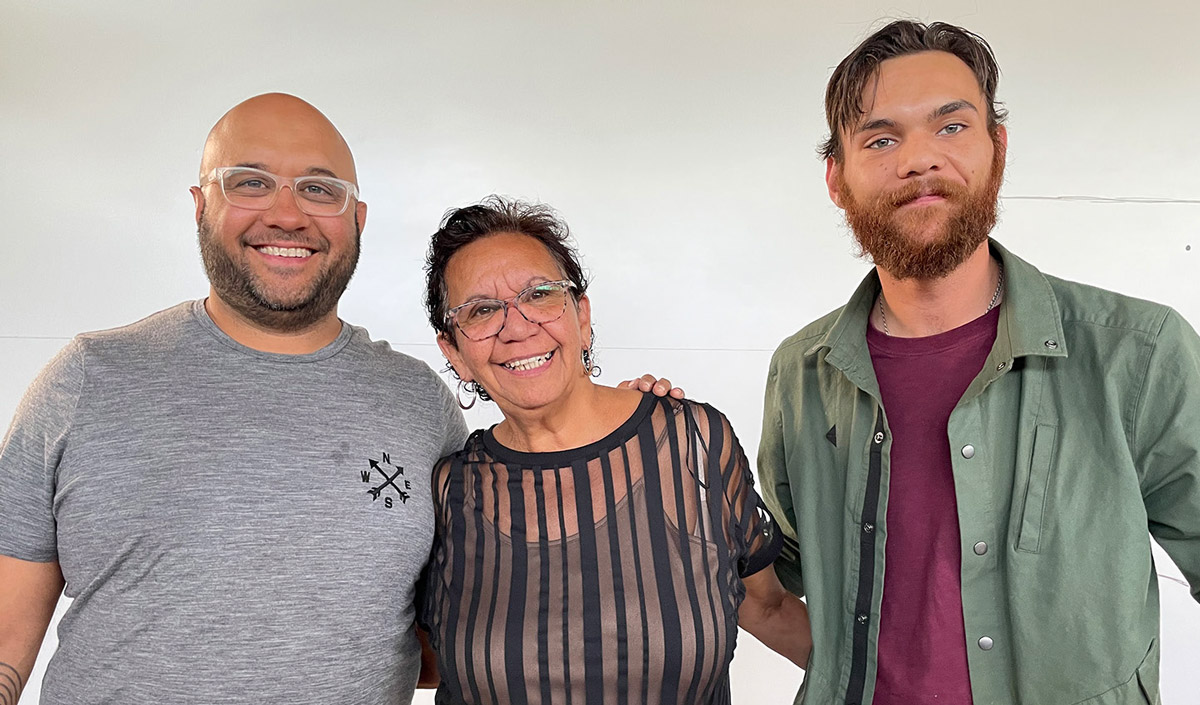
FAMILY HISTORY… The majority owner of First Person Films Daniel King, Irene Walker and Conor Baillie who is also working on the film alongside his mother and brother.